What to understand
For the first pass, focus on electrons, u and d quarks, and neutrinos. Protons and neutrons are composite objects made from quarks.
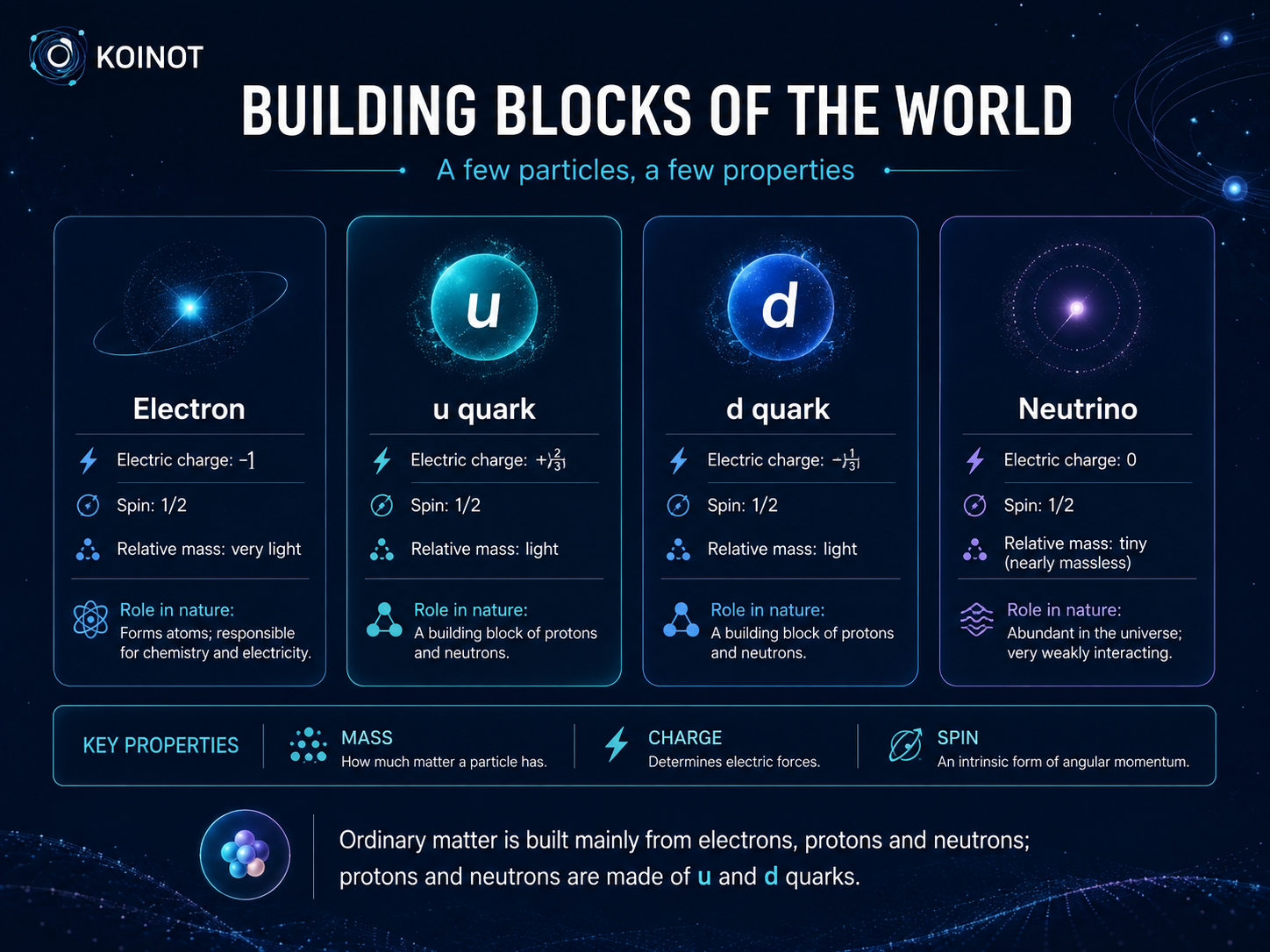
- Particles are characterized by properties such as mass, electric charge and spin.
- The electron participates in atomic structure and chemistry.
- u and d quarks provide the valence content of protons and neutrons.
- Neutrinos interact very weakly and are important in nuclear and astrophysical processes.
Understand in more depth
In the Standard Model, elementary particles are organized into fermions and bosons. Quarks and leptons are fermions. Gauge bosons mediate the electromagnetic, weak and strong interactions, while the Higgs field is associated with electroweak symmetry breaking and particle masses. For the construction of ordinary matter, the electron and the u and d quarks are the most immediately important.
Minimum formulas
History of the idea
The electron was identified at the end of the nineteenth century. The proton and neutron were established in the early twentieth century. Quarks were introduced in the 1960s to organize hadrons, and the modern Standard Model emerged through the unification of electroweak theory with quantum chromodynamics.
What remains open
Why the Standard Model has its particular particle families, masses, mixing parameters and interaction strengths remains unexplained at a deeper level. The nature of dark matter is also not identified within the minimal Standard Model.