What to understand
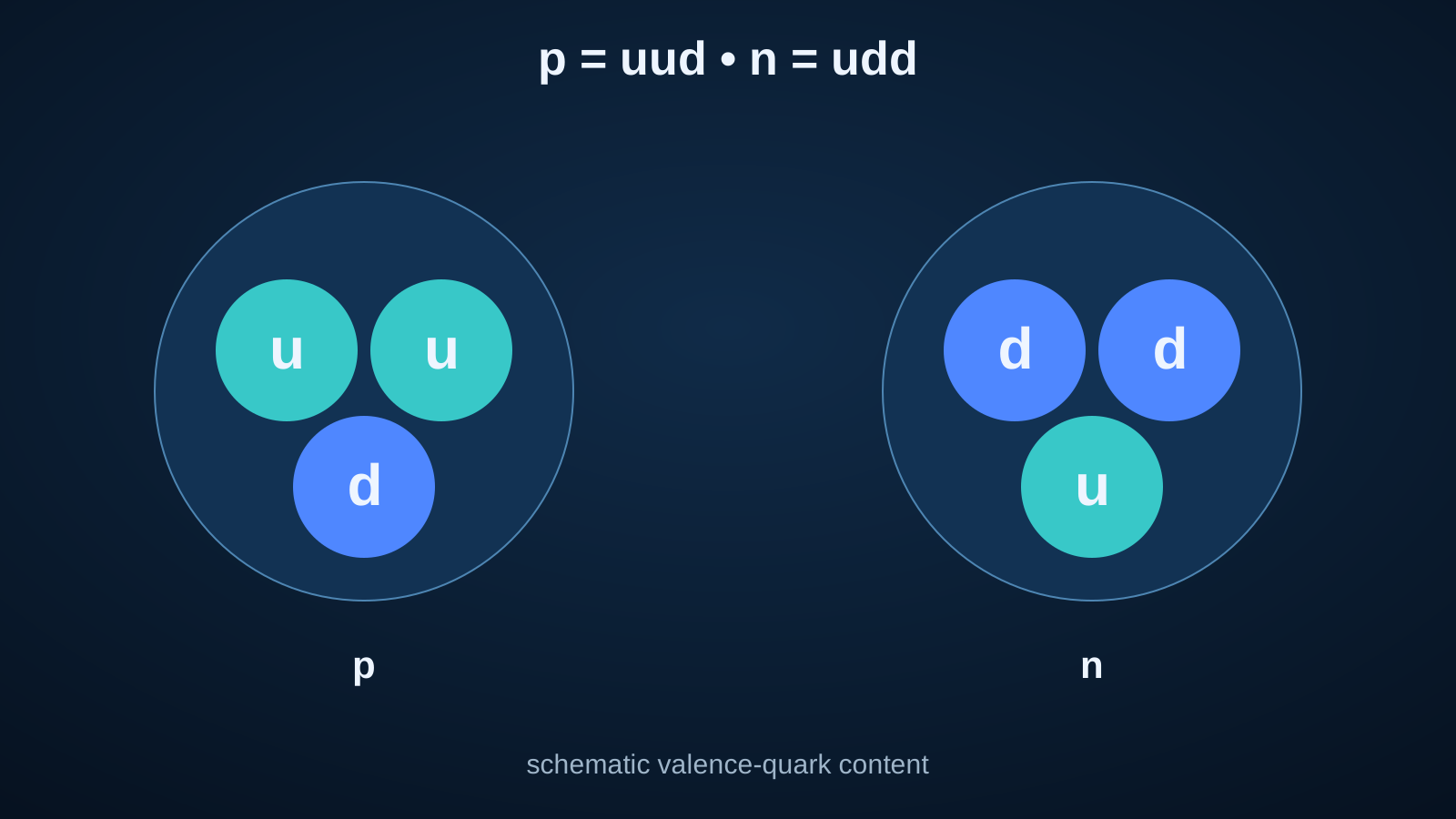
In a simple valence-quark picture, the proton has composition uud and the neutron udd. The full quantum-chromodynamic state also includes gluon fields and quark–antiquark contributions.
- Proton electric charge is +1 in elementary-charge units.
- Neutron net electric charge is 0.
- Both are spin-1/2 baryons.
- They form the basic constituents of ordinary atomic nuclei.
Understand in more depth
A proton or neutron is not a rigid bag containing exactly three quarks. The labels uud and udd describe valence content. The full quantum state contains gluon fields and virtual quark–antiquark contributions. Most of the nucleon mass arises from QCD dynamics rather than from the bare masses of the light quarks alone.
Minimum formulas
History of the idea
The proton was identified as the hydrogen nucleus. The neutron was discovered in 1932. The quark model of the 1960s explained regularities among hadrons, and quantum chromodynamics provided the field-theoretic description of the strong interaction.
What remains open
The internal structure of nucleons is still an active precision-research area, especially spin decomposition, parton distributions and the transition between quark-gluon and hadronic descriptions.