What to understand
Gravity, electromagnetism, the weak interaction and the strong interaction differ in what they act on, their relative strength, range and physical role.
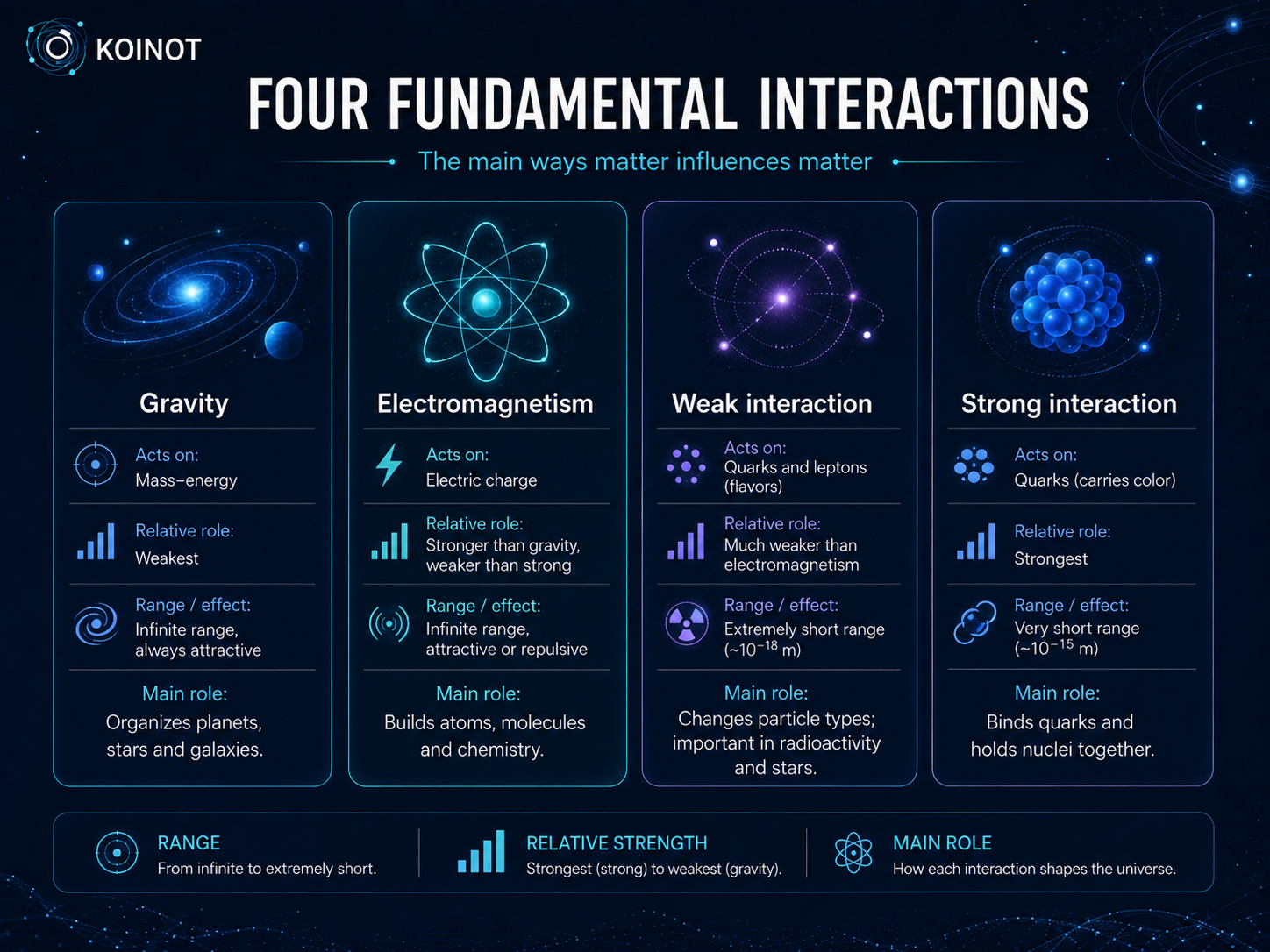
- Gravity organizes matter on large scales.
- Electromagnetism builds atoms, molecules and chemistry.
- The strong interaction binds quarks and is central to nuclear structure.
- The weak interaction changes particle types and is essential in radioactive and stellar processes.
Understand in more depth
The four fundamental interactions operate on very different scales. Electromagnetism and gravity have long range. The strong interaction is confined to hadronic and nuclear scales, while the weak interaction acts at very short distances. Their strengths cannot be compared by a single number without specifying energy and process.
Minimum formulas
History of the idea
Newtonian gravity and classical electromagnetism were the first universal interactions to receive mathematical formulations. In the twentieth century, weak and strong interactions were identified through nuclear and particle phenomena. Gauge-field theory later unified electromagnetism and the weak interaction within the electroweak framework.
What remains open
Until recently there was no generally accepted fully satisfactory quantum theory of gravity. CTPA has recently proposed a resolution of this problem without introducing new physical hypotheses: starting from established facts and the physical principles of general relativity, the external gravitational field of high-energy virtual intermediate states is included. As the total physical energy of the particle system approaches the Planck scale, gravitational time slowing and freezing of local processes produces a physical boundary of order M_P, so loop integrals become finite. This is a result of the CTPA research program and is not yet a mainstream consensus. It also remains open whether all interactions are manifestations of a deeper unified structure.
Where to go next
Suggested sources
CTPA: the quantum-gravity ultraviolet problem
The conventional formulation above treats perturbative quantum gravity as nonrenormalizable. CTPA claims a physical resolution through Planck-scale gravitational self-regularization.
Open CTPA comparison