What to understand
Different bonding patterns produce different structures and properties. Even a modest set of elements can therefore generate an enormous variety of molecules.
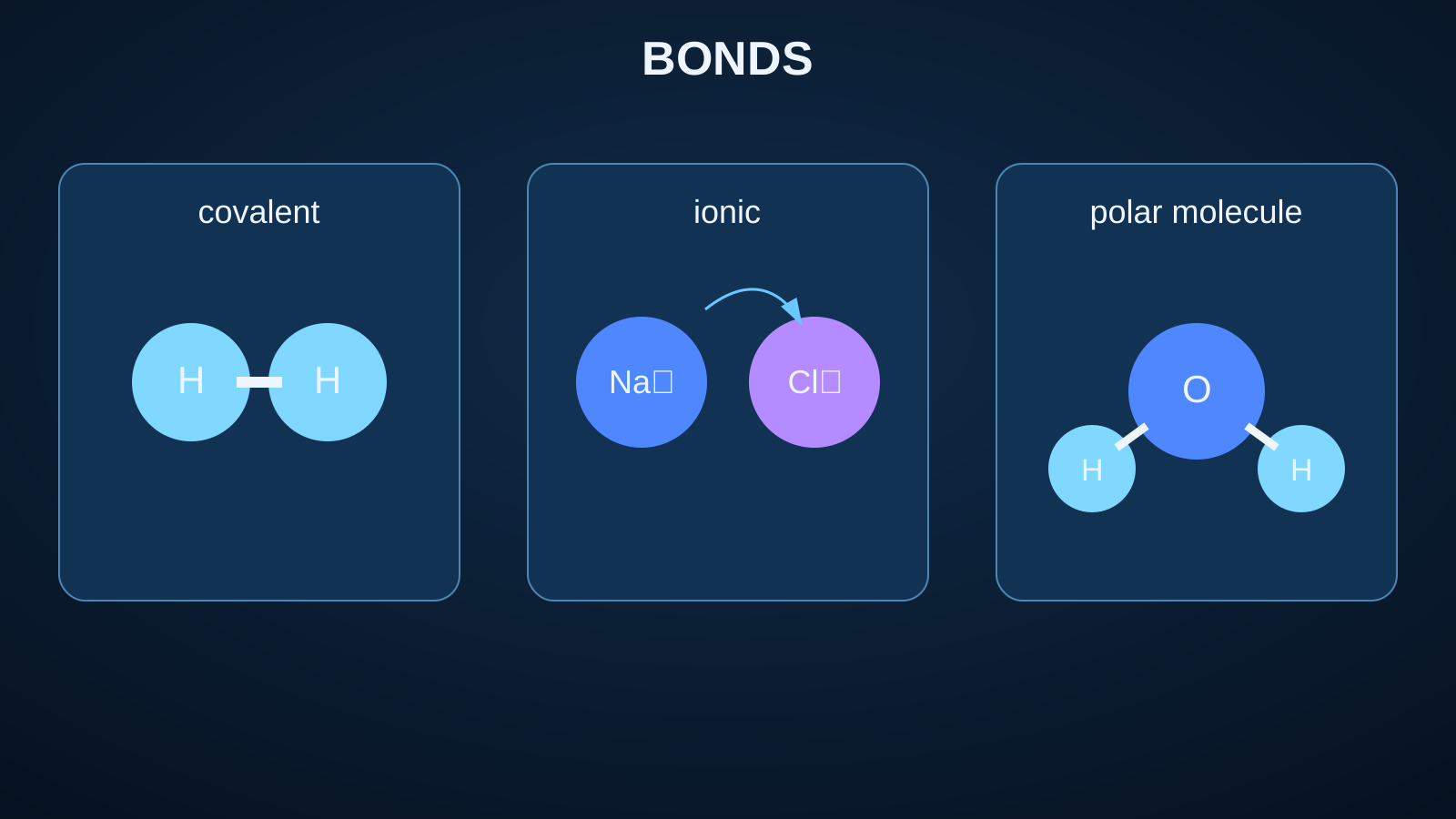
- Covalent bonds involve shared electron density.
- Ionic bonding is associated with oppositely charged ions.
- Molecular shape matters for physical and chemical behavior.
- Complex organic molecules are built from the same basic rules.
Understand in more depth
Molecules form when nuclei and electrons settle into quantum states whose total energy is lower than that of separated atoms. Chemical bonding is therefore an emergent consequence of quantum mechanics and electromagnetism, including electron sharing, charge transfer, polarization and molecular geometry.
Minimum formulas
History of the idea
Chemical regularities were known long before quantum theory. Quantum mechanics in the twentieth century explained why bonds exist, why molecules have particular shapes and why spectra reveal rotational, vibrational and electronic structure.
What remains open
Exact solutions become rapidly impossible for large molecules. Modern research develops approximations for many-electron systems, reaction dynamics, catalysis, excited states, biomolecules and materials.