What to understand
Temperature, pressure, elasticity, conductivity, viscosity and phase behavior are not properties of a single isolated atom in the same sense; they emerge from many-particle organization.
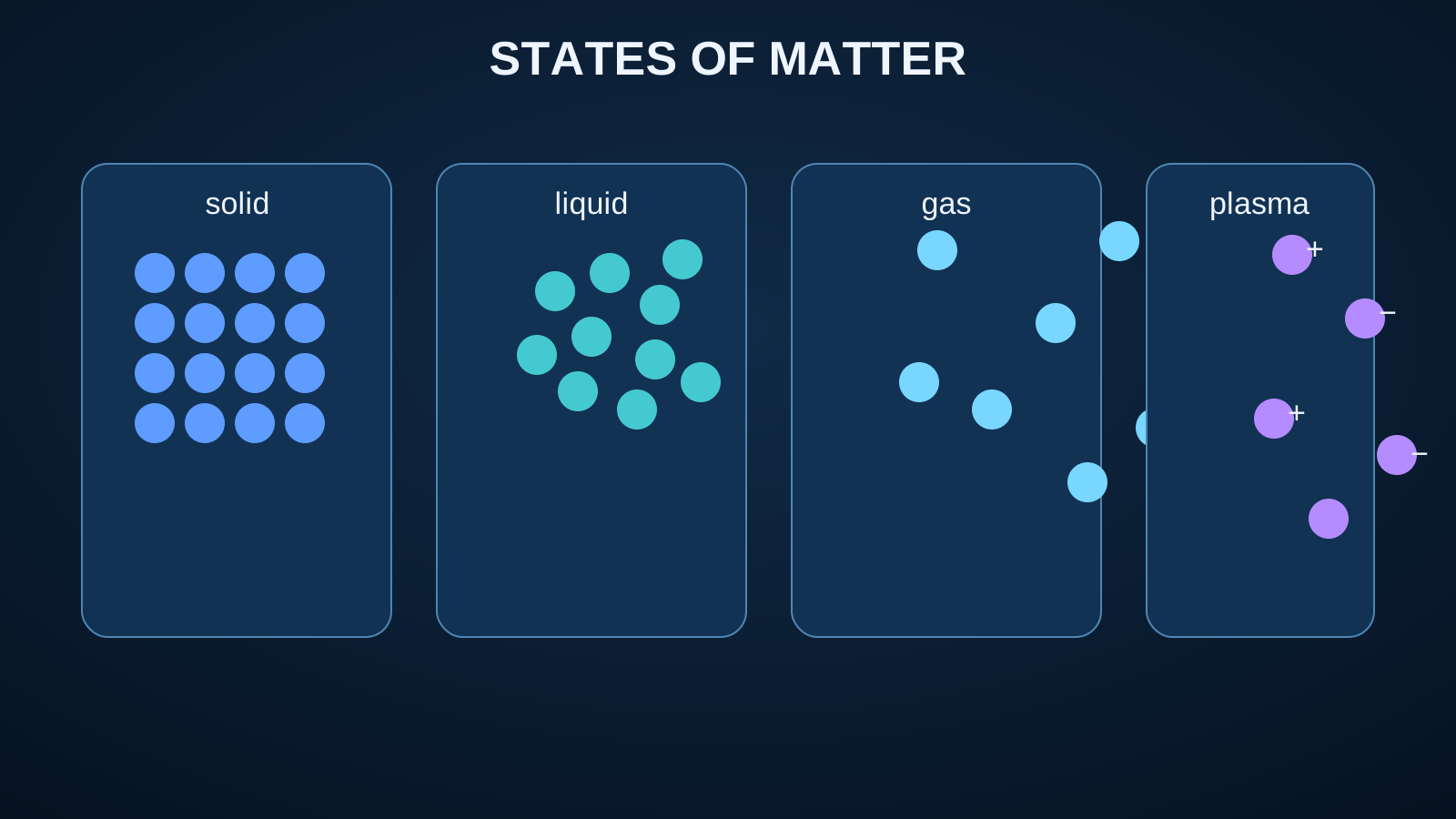
- Solids retain shape because their constituents are strongly organized.
- Liquids flow while remaining dense.
- Gases are much more dilute and compressible.
- Plasma contains mobile charged particles and is common in stars.
Understand in more depth
Macroscopic matter is described statistically because it contains enormous numbers of particles. Temperature, pressure and phase are collective variables. Microscopic interactions determine the possible phases, but macroscopic behavior often has universal features that do not depend on every molecular detail.
Minimum formulas
History of the idea
Thermodynamics was developed before atoms were universally accepted. Statistical mechanics later connected temperature and entropy with microscopic motion and probability, providing a bridge between particle physics and macroscopic matter.
What remains open
Many-body physics remains a major research field. Strongly correlated matter, superconductivity, quantum phases, glasses, turbulence and nonequilibrium systems still contain fundamental open problems.