What to understand
Nuclear binding reflects the residual strong interaction between nucleons. The balance between attraction, electric repulsion and quantum structure determines which nuclei are stable.
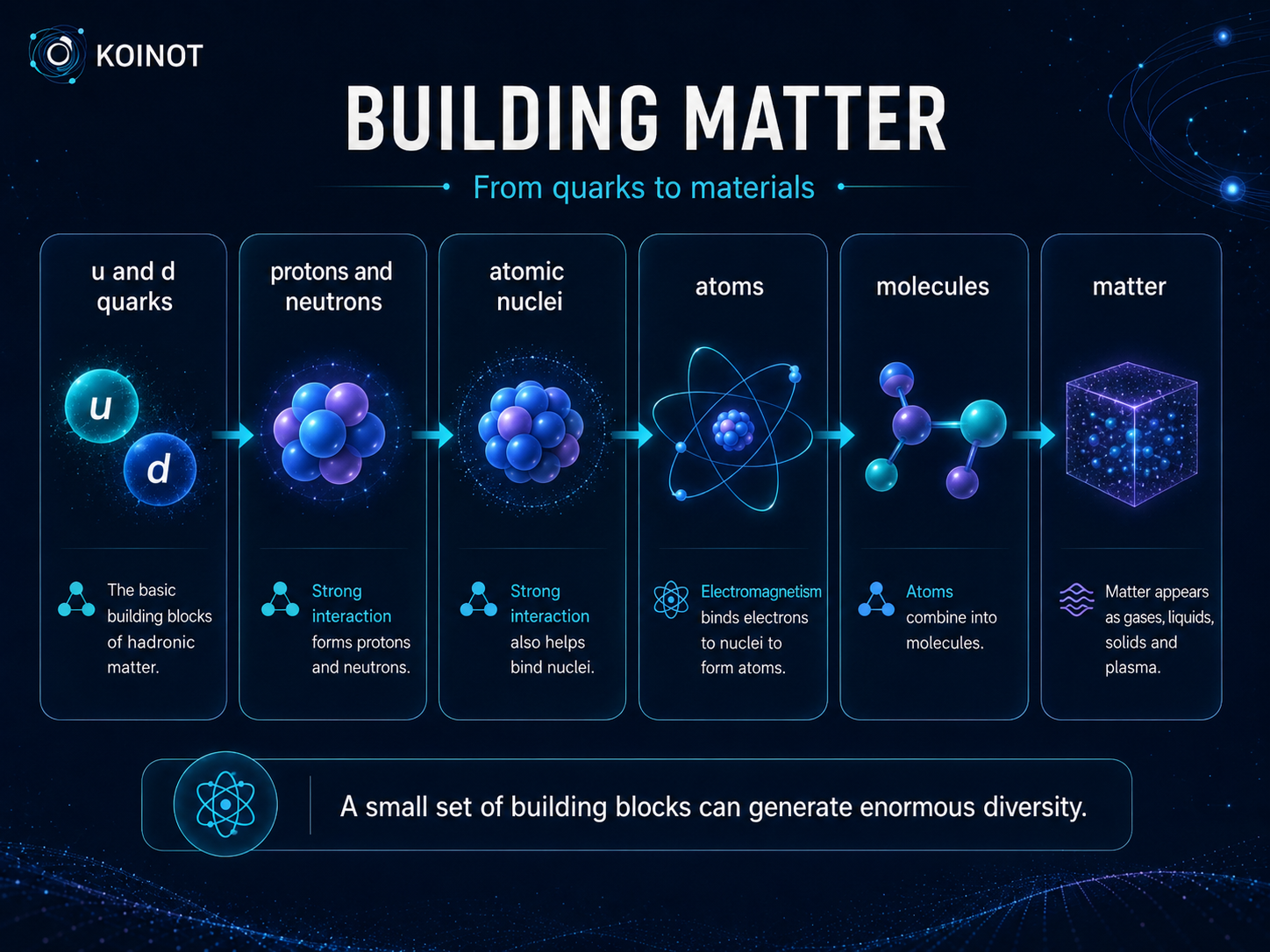
- Hydrogen-1 has a single proton.
- Helium nuclei contain protons and neutrons.
- Different proton numbers define different chemical elements.
- Different neutron numbers produce isotopes.
Understand in more depth
An atomic nucleus is a quantum many-body system of protons and neutrons. Nuclear binding is not a simple pairwise force alone: spin, isospin, quantum statistics and many-body effects matter. The stability of a nucleus results from the balance between nuclear attraction, proton-proton electric repulsion and shell structure.
Minimum formulas
History of the idea
Rutherford’s scattering experiments established the nuclear atom. The proton and neutron were identified in the early twentieth century, and nuclear shell, liquid-drop and quantum many-body models were developed to explain binding, spectra, decay and reactions.
What remains open
A fully controlled description of all nuclei directly from quantum chromodynamics remains extremely difficult. Nuclear forces, exotic nuclei, neutron-rich matter and the equation of state of dense nuclear matter are active research areas.