Slide 1
The world looks extremely complex
Yet the fundamental building blocks and rules are comparatively few.
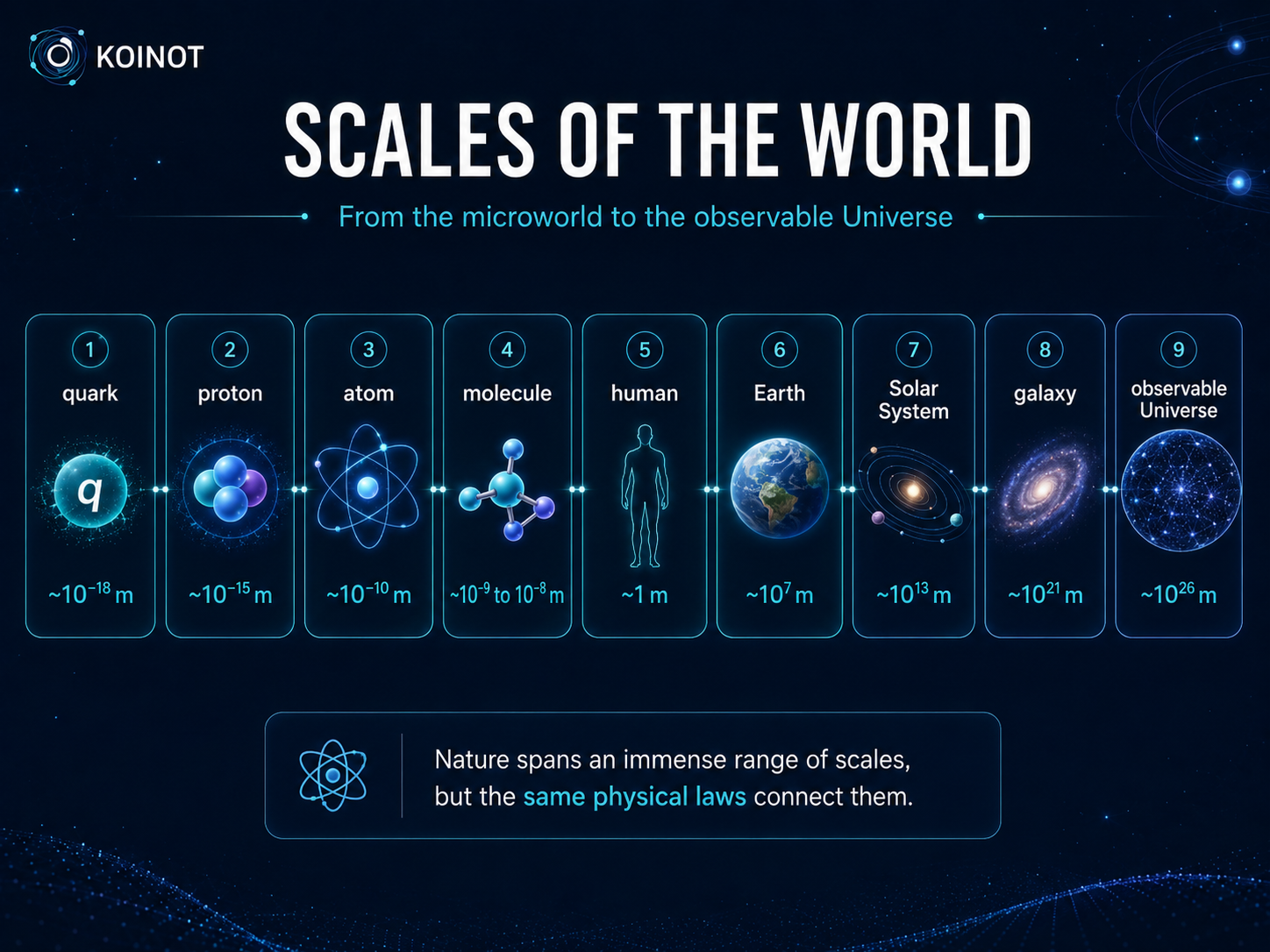
Let us build the physical world almost from scratch: space and time, a small set of particles and interactions, then nuclei, atoms, molecules, matter, planets, stars, galaxies and the Universe.
VisualsParticles → nuclei → atoms → molecules → matter → planets → stars → galaxies → Universe
Interactive presentation built directly into the website.
Yet the fundamental building blocks and rules are comparatively few.
All physical processes unfold in space and time.
A small set of particles carries a small set of basic properties.
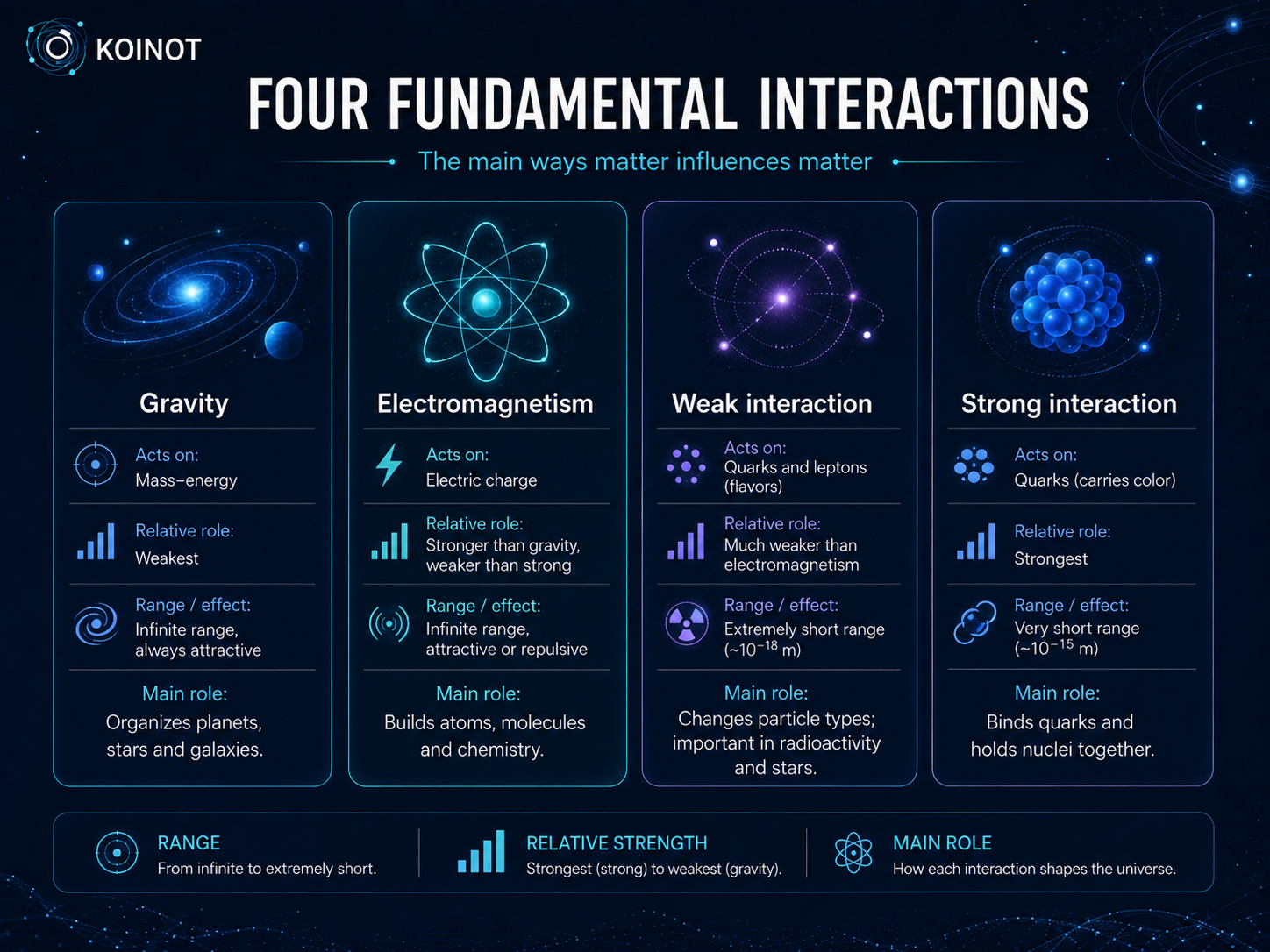
Four fundamental interactions govern how the building blocks influence one another.
Quarks → protons and neutrons → nuclei.
Nuclei + electrons → atoms.
Atoms → molecules → materials.
Matter → planets and stars.
Stars → systems → galaxies → large-scale structure.
The same basic ingredients and laws operate across the physical world.
Everything in the physical world unfolds in space and time. Classical physics describes slow motion, relativity is needed for motion near light speed, and quantum behavior becomes essential in the microworld.
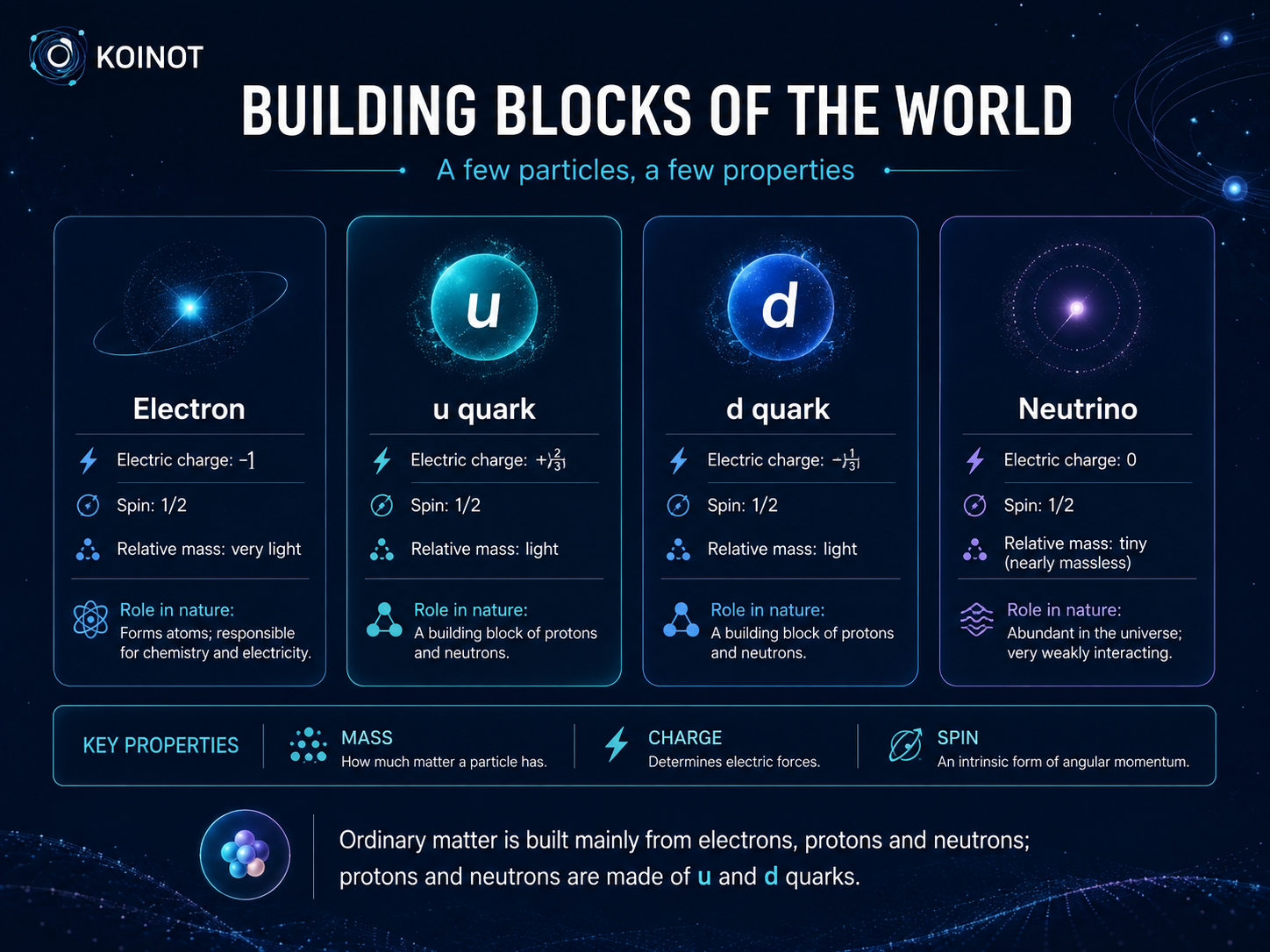
The diversity of visible objects rests on a comparatively small set of fundamental constituents. Ordinary matter is built mainly from electrons and light quarks, with neutrinos important in nuclear and astrophysical processes.
Gravity, electromagnetism, the weak interaction and the strong interaction provide the basic ways in which particles and systems affect one another.
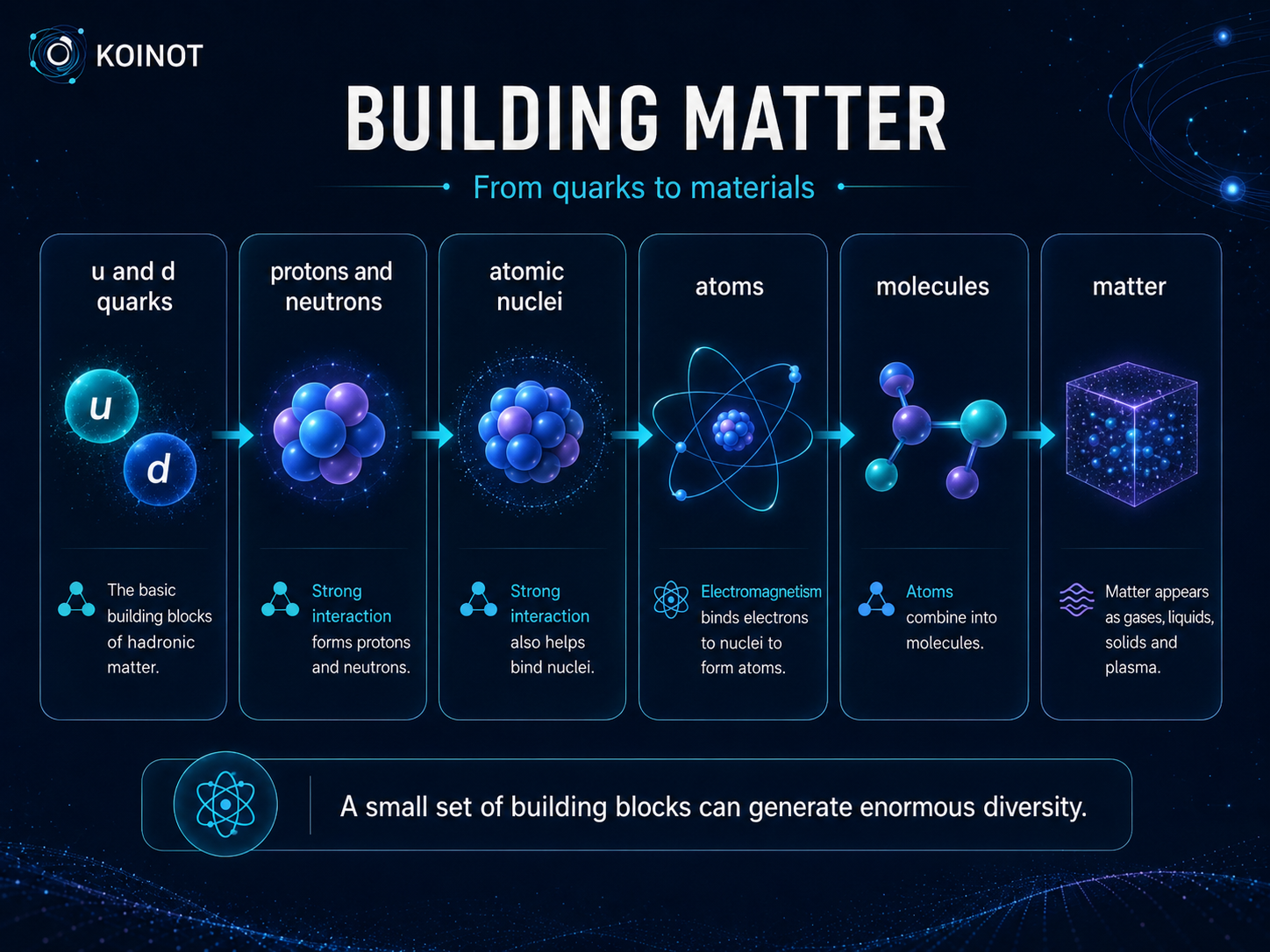
Light quarks form protons and neutrons; protons and neutrons combine into atomic nuclei.
Positively charged nuclei bind negatively charged electrons, producing atoms and the chemical elements.
Atoms form molecules; atoms and molecules form gases, liquids, solids and plasma.
On large scales gravity organizes matter, producing planets and compressing sufficiently massive gas clouds until stars ignite.
Stars, planets, smaller bodies, gas and dust form stellar systems.
Stellar systems, gas, dust and other components form galaxies, groups and clusters.
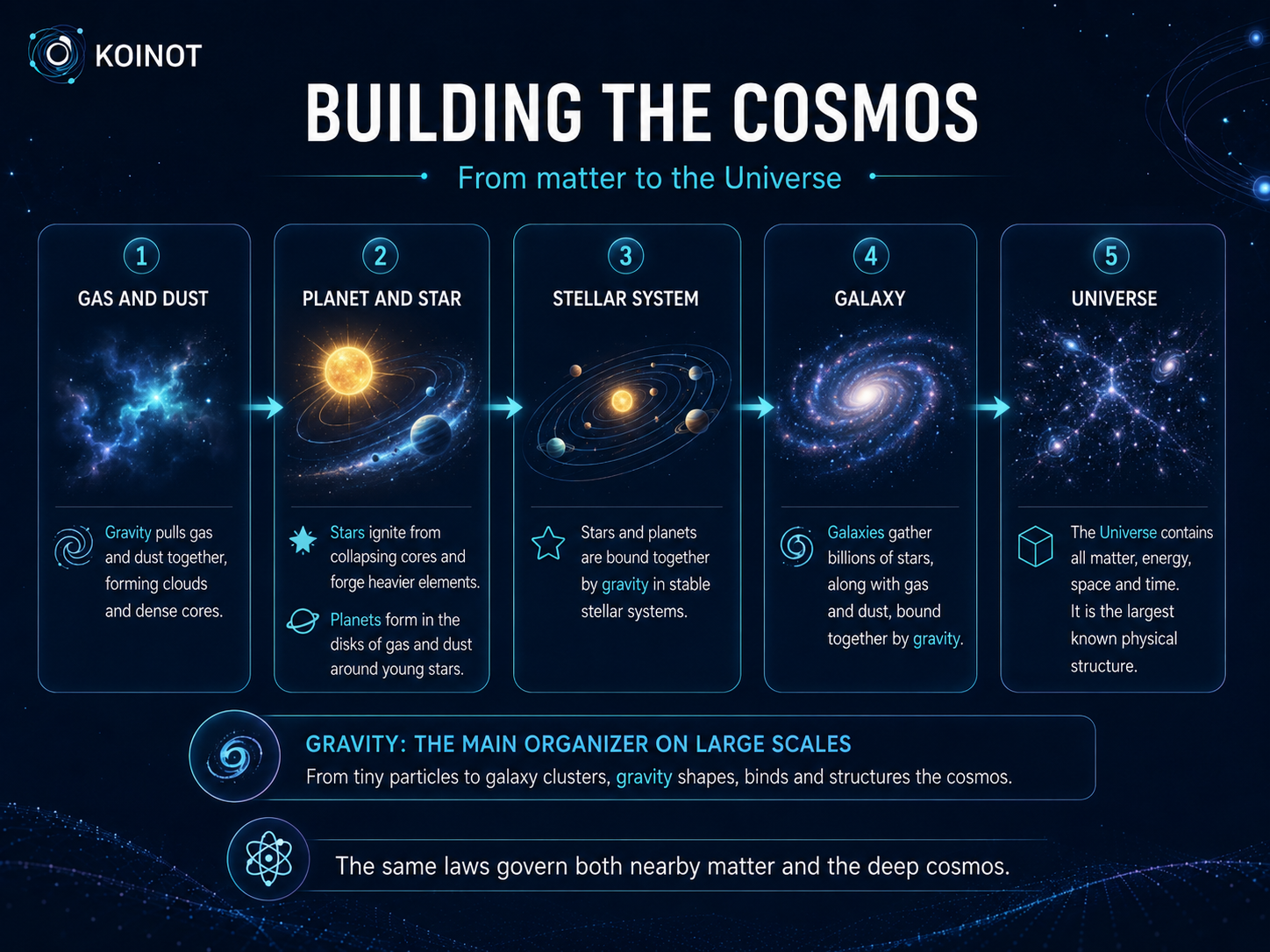
Cosmic structures together form the observable Universe, whose evolution and expansion are studied by cosmology.
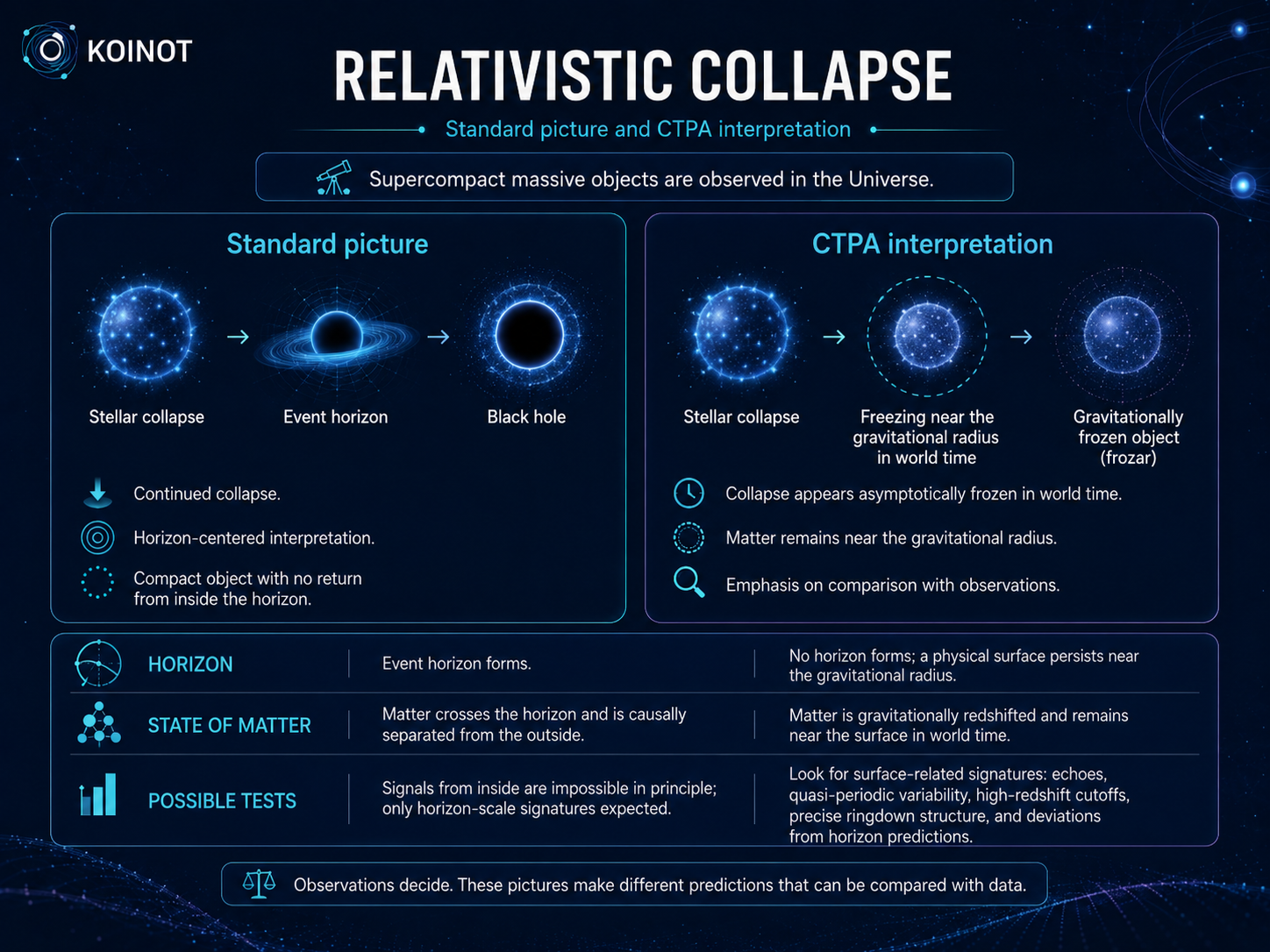
Questions about the origin of particle families, unification, quantum gravity, compact objects and cosmology lead to the research frontier.
Where CTPA offers a different interpretation, KOINOT separates empirical facts from interpretation, presents both pictures in parallel, and compares assumptions, predictions and possible tests.