What to understand
Gravity compresses gas. When the central temperature and density become high enough, nuclear fusion can sustain a star against further collapse for a long period.
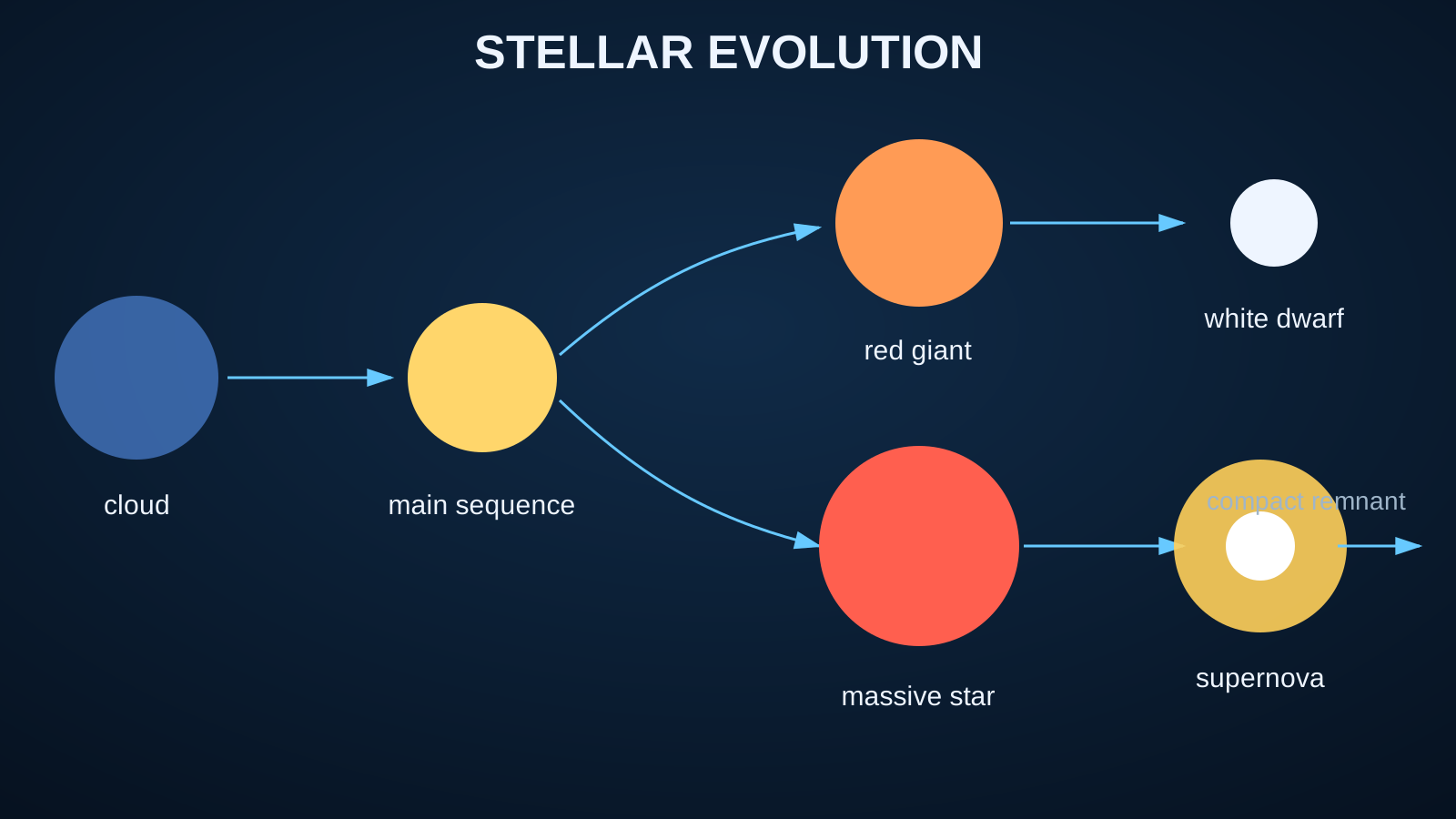
- Stars form from dense regions in interstellar gas.
- Hydrostatic balance links gravity with pressure.
- Mass is a primary parameter governing stellar lifetime and evolution.
- Late evolution can produce white dwarfs, neutron stars or relativistic collapse depending on mass and other conditions.
Understand in more depth
A star is a self-gravitating plasma sphere in which gravity is balanced for long periods by pressure. Main-sequence stars obtain most of their luminosity from nuclear fusion of hydrogen into helium. Mass determines central conditions, luminosity, lifetime and the broad evolutionary path.
Minimum formulas
History of the idea
The nineteenth century established stellar spectroscopy. Nuclear physics in the twentieth century solved the long-standing problem of stellar energy sources. Modern stellar evolution combines hydrostatic structure, energy transport, nuclear reaction networks and observation.
What remains open
Open problems include detailed convection, magnetic activity, rotation, mass loss, supernova mechanisms and the physics of compact remnants.