What to understand
The internal structure of galaxies reflects gravity, orbital dynamics, star formation and the history of mergers and interactions.
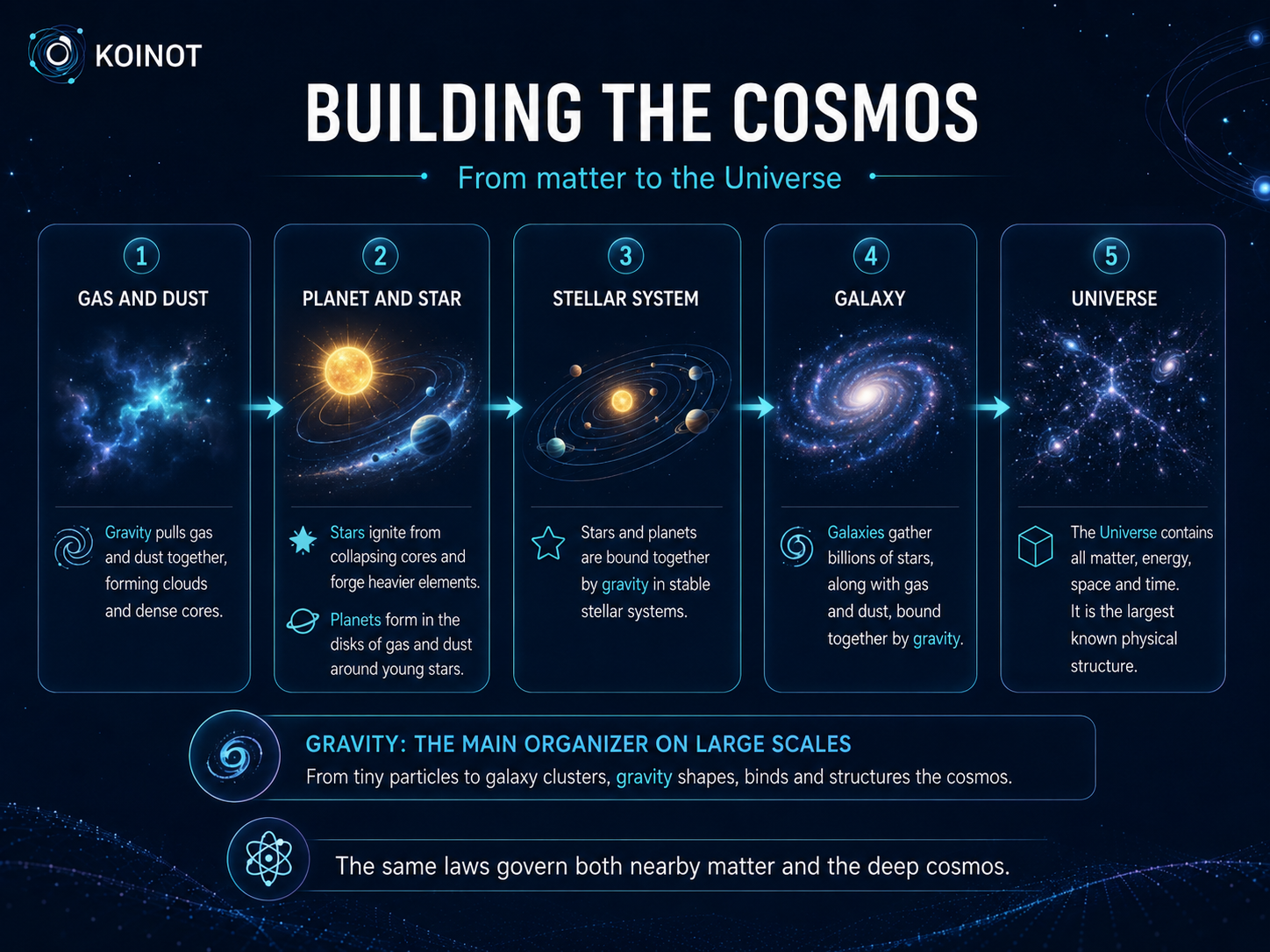
- Galaxies come in spiral, elliptical and irregular forms.
- Stars orbit within a collective gravitational potential.
- Gas and dust provide material for new stars.
- Galaxies form groups, clusters and larger cosmic structures.
Understand in more depth
A galaxy is a dynamical system containing stars, gas, dust, stellar remnants and a gravitational mass component inferred from motions and lensing. Galaxies evolve through internal processes, star formation, gas accretion and mergers. Their structure therefore records both local physics and cosmic history.
Minimum formulas
History of the idea
Galaxies were established as external stellar systems in the early twentieth century. Later observations revealed rotation curves, active galactic nuclei, galaxy clusters and a cosmic web, linking galactic astronomy with cosmology.
What remains open
Major open problems include the detailed nature of dark matter, feedback from stars and active nuclei, the transformation of galaxy morphology, and the co-evolution of galaxies with their central compact objects.