What to understand
The modern observational picture combines cosmic expansion, the cosmic microwave background, primordial-element abundances and the growth of large-scale structure.
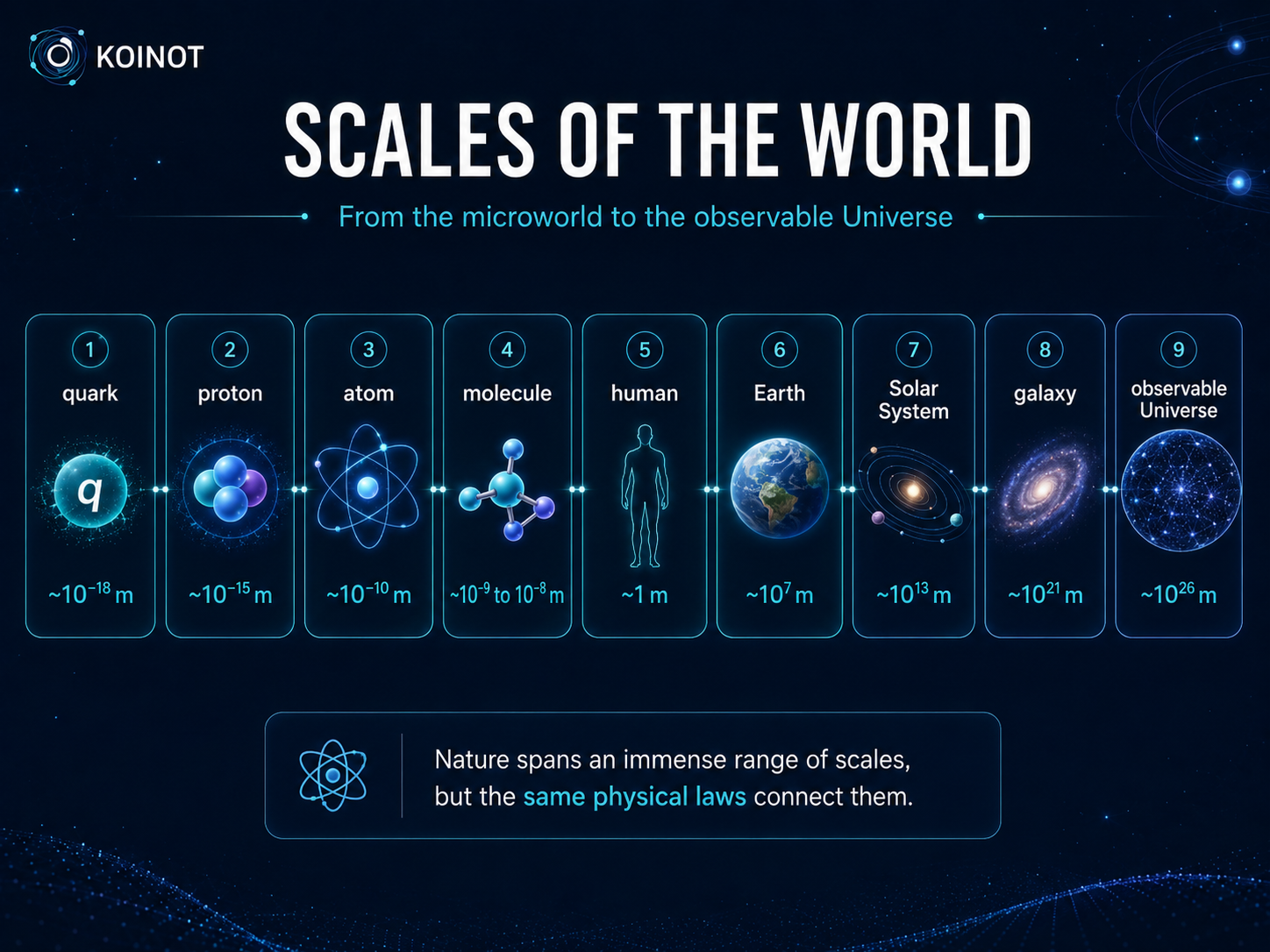
- Cosmological redshift is a central observational tool.
- The observable Universe has a finite look-back time.
- Large-scale structure grew from earlier density variations.
- Dark matter, dark energy and the earliest physical regime remain major research questions.
Understand in more depth
Modern cosmology uses general relativity together with large observational datasets. On sufficiently large scales the Universe is modeled statistically as homogeneous and isotropic. Expansion is described by a time-dependent scale factor, while the contents of the Universe determine its evolution through Einstein’s equations.
Minimum formulas
History of the idea
Relativistic cosmology began after general relativity. Friedmann and Lemaître found expanding solutions; Hubble’s observations established the distance-redshift relation. The cosmic microwave background and precision surveys later turned cosmology into a quantitative observational science.
What remains open
The physical nature of dark matter and dark energy remains unresolved. The earliest epoch, the origin of initial conditions, and the relation between cosmology and quantum gravity are also open questions.
Where to go next
Suggested sources
CTPA interpretation: Diffusion Gravity
Where the standard page lists dark matter and gravitational foundations as open problems, CTPA provides a different route: gravitation is derived from inhomogeneity of the background scalar field, with astrophysical and cosmological consequences.
Open Diffusion GravityCTPA comparison: cosmological redshift
The standard scale-factor description and the CTPA decomposition into local gravitational, propagation and kinematic contributions are compared separately.
Open comparison