KOINOT · Comparative presentation

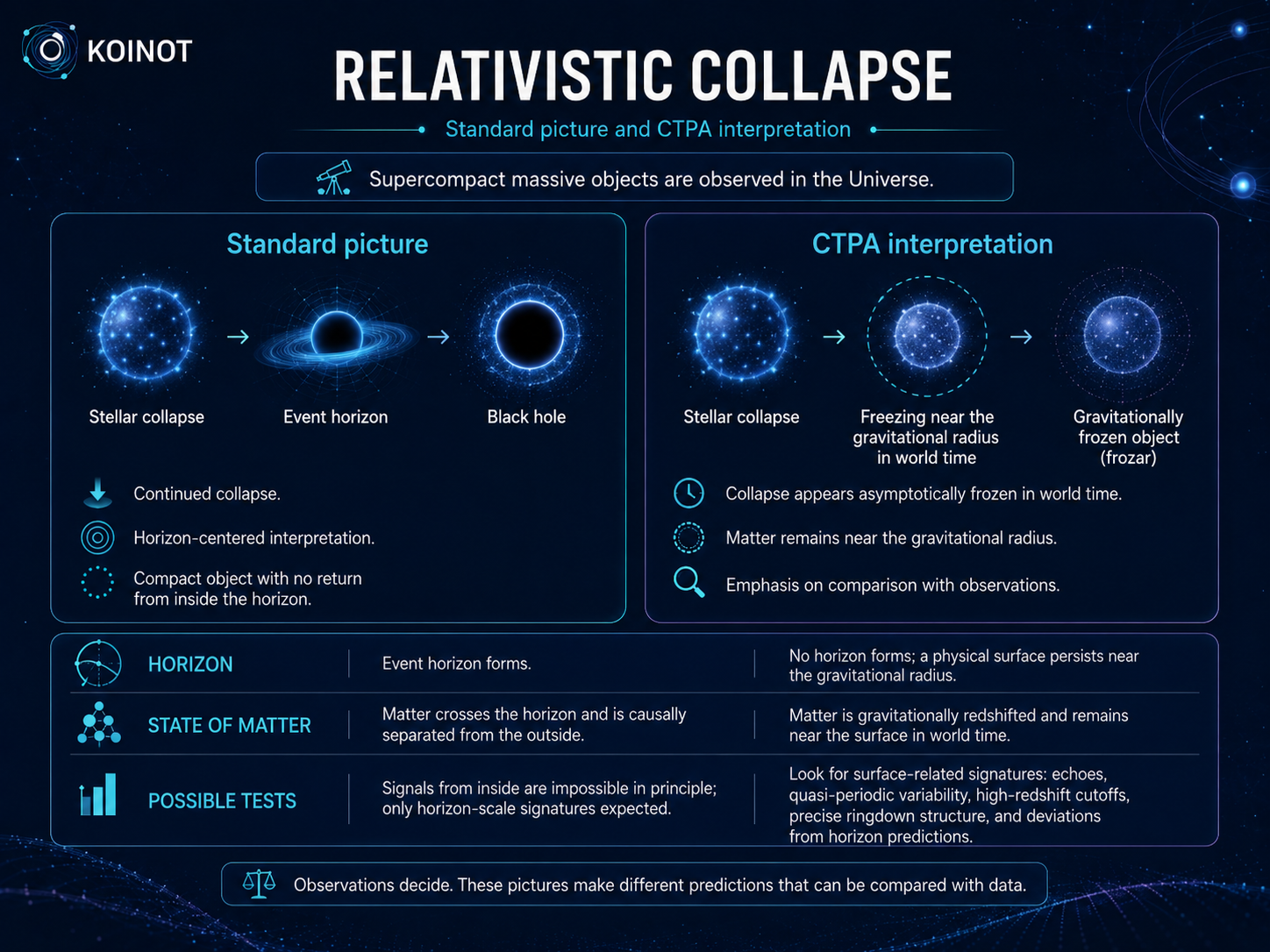
Relativistic collapse: two interpretations

The same observational domain can be organized into different theoretical pictures. KOINOT first separates the empirical basis from interpretation, then compares the pictures by the same criteria.

KOINOT will keep the empirical statements, the standard interpretation, and the CTPA interpretation visually distinct. A proposal becomes scientifically stronger when it identifies observations that could in principle distinguish it from alternatives.
FACT / EMPIRICAL BASIS

Common empirical basis

Astronomical observations reveal very compact massive objects, strong gravitational fields, accretion flows, relativistic jets in some systems, gravitational-wave signals from compact-object mergers, and horizon-scale images or constraints in selected sources.

Relativistic collapse: two interpretations
Standard picture

Standard contemporary picture

  • Gravitational collapse can produce a black hole with an event horizon.
  • The exterior field is described by relativistic spacetime geometries such as Schwarzschild or Kerr in the appropriate idealized limits.
  • Matter can cross the horizon in its proper time; signals from inside cannot return to the external region.
  • The black-hole interpretation is the mainstream framework used for compact-object astrophysics.
CTPA interpretation

CTPA interpretation

  • CTPA describes the collapse in terms of a global/world-time slicing in which infalling matter asymptotically approaches the gravitational radius.
  • The compact object is interpreted as a gravitationally frozen configuration (frozar) rather than a region with a formed event horizon.
  • The exterior gravitational field can closely reproduce standard compact-object phenomenology while the physical interpretation of the near-surface region differs.
  • The interpretation is therefore presented as an alternative research program requiring comparison with observations.
CriterionStandard pictureCTPA interpretation
Starting pointRelativistic collapse and standard black-hole spacetime interpretation.Relativistic collapse described with emphasis on world-time simultaneity.
HorizonEvent horizon is part of the physical description.No formed horizon at finite world time; matter remains near the gravitational radius.
Exterior fieldSchwarzschild/Kerr-type exterior in idealized cases.Exterior field can be very similar or identical in the corresponding idealized exterior region.
Main empirical taskTest black-hole predictions and strong-field GR.Look for observations capable of distinguishing a horizon from a material/frozen near-surface configuration.
StatusMainstream interpretation.CTPA research interpretation; not an established consensus result.

How can they be distinguished?

ImagingLook for robust deviations from standard horizon-scale morphology after controlling for plasma and model uncertainties.
Time variabilitySearch for reproducible surface-related or near-surface signatures that cannot be reproduced by ordinary accretion-flow physics.
Gravitational wavesCompare merger and ringdown signals with precise strong-field predictions and alternative compact-object models.